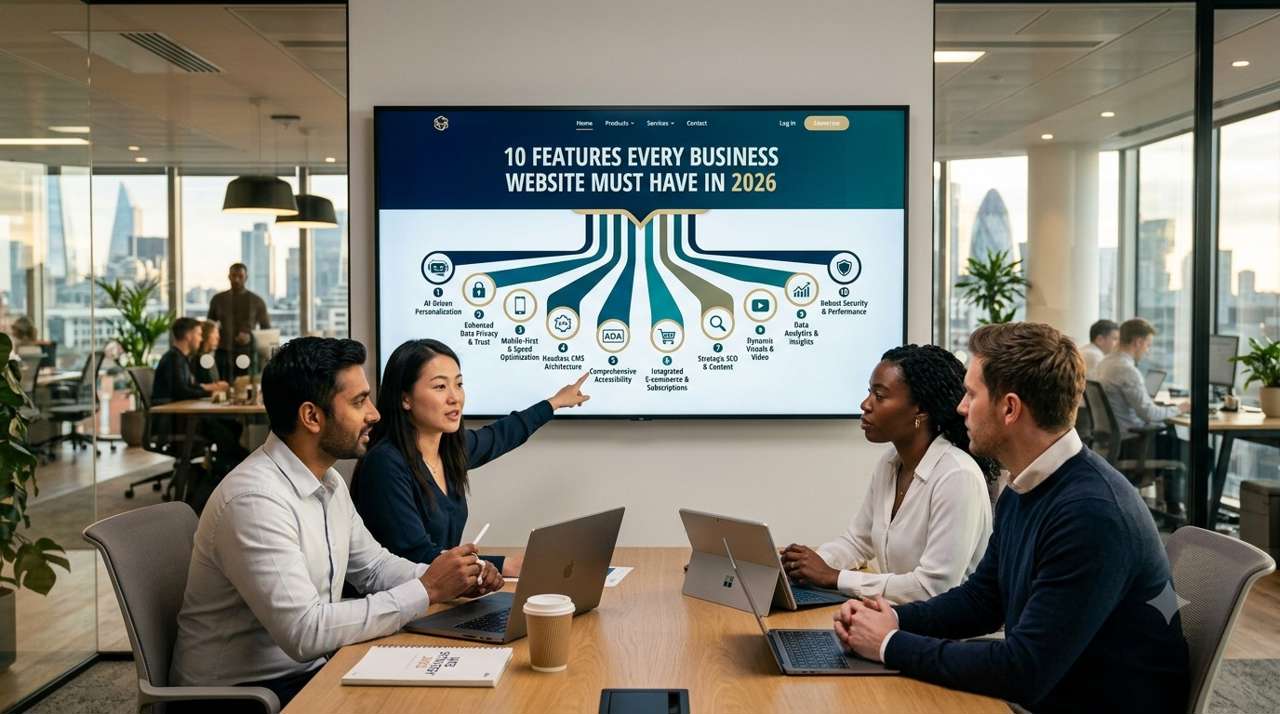
10 Features Every Business Website Must Have in 2026
A business website in 2026 is much more than an online brochure.
Your website is often the first place where a potential customer learns about your business, checks your credibility, compares your services and decides whether to contact you.
At the same time, the way people discover businesses is changing. Customers are using traditional Google Search as well as AI-powered search experiences to find information, products and services.
That means a modern business website needs to be fast, mobile-friendly, search-friendly, trustworthy and ready for the future.
Here are the 10 essential features every business website should have in 2026.
1. Mobile-First Responsive Design
Most customers are likely to interact with your business through a smartphone.
A website that looks excellent on a desktop but is difficult to use on a mobile phone can quickly lose potential customers.
A modern website should:
- Work smoothly on smartphones, tablets and desktops
- Have readable text without zooming
- Use mobile-friendly navigation
- Have buttons that are easy to tap
- Display images and content correctly on different screen sizes
- Provide a consistent experience across devices
Mobile responsiveness is no longer an optional feature. It is a basic requirement for a professional business website.
2. Fast Loading Speed
Nobody likes waiting for a slow website.
If your website takes too long to load, visitors may leave before they even see your services.
A future-ready website should be optimized for performance through:
- Optimized images
- Modern image formats such as WebP or AVIF where appropriate
- Minified CSS and JavaScript
- Efficient caching
- Proper image dimensions
- Reduced unnecessary scripts
- Fast and reliable hosting
- Optimized fonts and third-party resources
Website performance also matters for Google's page experience and Core Web Vitals.
The goal is simple:
Your customer should be able to see useful content and interact with the website quickly.
3. SEO-Friendly Website Architecture
Having a beautiful website is not enough if search engines cannot properly understand it.
Your website should be built with SEO in mind from the beginning.
Important elements include:
- Clean and logical URLs
- Proper title tags
- Unique meta descriptions
- Correct H1, H2 and H3 heading structure
- Canonical URLs
- XML sitemap
- Robots.txt
- Internal linking
- Descriptive image ALT text
- Crawlable content
- Proper redirects
- Structured data where appropriate
SEO should not be treated as something added to a website months after development.
SEO-friendly architecture should be part of the development process from day one.
4. AI-Search-Ready Content
Search is evolving.
Users are increasingly interacting with AI-powered search experiences, which means businesses need to think beyond traditional keyword rankings.
However, being "AI-ready" does not mean filling your website with AI-generated text or creating special files just for AI systems.
Google's current guidance emphasizes continuing to follow strong SEO fundamentals while creating unique, useful and reliable content for people.
Your website should clearly explain:
- Who you are
- What you offer
- Who your services are for
- Where you operate
- What makes you different
- Frequently asked customer questions
- Pricing or starting information where appropriate
- How customers can contact you
Create content that answers real customer questions.
Build for people first, and make the information easy for search systems to understand.
5. Clear Calls-to-Action
One of the biggest mistakes businesses make is having a website that looks good but doesn't tell visitors what to do next.
Every important page should have a clear next step.
For example:
Get a Quote
Call Us
Book a Consultation
Request a Callback
WhatsApp Us
Buy Now
Schedule a Demo
Don't make visitors search for your contact details.
A good website guides visitors from:
Information → Trust → Action
Your website should make that journey as simple as possible.
6. Trust and Credibility Signals
Before contacting a business, customers want to know whether they can trust it.
Your website should make credibility obvious.
Consider including:
- Real customer reviews
- Testimonials
- Business address
- Phone number
- Email address
- Google Business Profile information
- Client logos
- Certifications
- Awards
- Case studies
- Portfolio
- Real photographs
- About Us information
- Privacy Policy
- Terms and conditions
Avoid fake reviews, exaggerated claims or misleading information.
Trust is important not only for customers but also for the overall quality of your website.
7. Structured Data and Schema Markup
Search engines need to understand what your website and its pages represent.
Structured data can help communicate information about entities such as:
- Organization
- Local Business
- Product
- Service
- Article
- Event
- Breadcrumbs
The correct structured data depends on the type of page and what information is actually present.
It should never be added simply to manipulate search results.
Google continues to update which structured-data features are supported, so businesses should use only relevant and currently supported markup.
8. Easy Content Management
A modern business should not need a developer every time it wants to update a phone number, service, product or image.
A good CMS should allow authorized users to easily manage:
- Website content
- Services
- Products
- Images
- Blog posts
- Testimonials
- FAQs
- Contact information
- SEO titles and descriptions
- Landing pages
This gives the business control over its website and makes future updates much easier.
A well-designed CMS also makes the website easier to scale as the business grows.
9. Analytics and Lead Tracking
Getting website visitors is only part of the story.
You also need to know what those visitors are doing.
A modern website should be connected to appropriate analytics and measurement tools so the business can understand:
- Where visitors come from
- Which pages they visit
- Which keywords generate visibility
- Which pages generate enquiries
- Which buttons people click
- How many forms are submitted
- How many calls or WhatsApp enquiries are generated
- Which marketing channels produce results
Instead of asking:
"How many people visited my website?"
business owners should also ask:
"How many qualified enquiries did my website generate?"
10. Security, Scalability and Future-Ready Technology
A website should be built not only for today's requirements but also for tomorrow's growth.
At a minimum, a business website should consider:
- HTTPS
- Secure forms
- Strong authentication for admin users
- Regular backups
- Secure database practices
- Protection against common web vulnerabilities
- Performance monitoring
- Scalable hosting
- Clean and maintainable code
- API-ready architecture
A future-ready architecture can also make it easier to add capabilities later, such as:
- AI assistants
- CRM integration
- WhatsApp automation
- Online booking
- Payment gateways
- Personalization
- Marketing automation
- Third-party APIs
The goal isn't to add every technology available today.
The goal is to build a strong foundation that can evolve as technology and business requirements change.
Bonus: Don't Build a Website Just for Google
One of the biggest misconceptions in digital marketing is that a website should be created only to rank on Google.
That's not enough.
Your website needs to satisfy several things at the same time:
Search Visibility + User Experience + Trust + Conversion + Performance
Google's current guidance for generative AI search also reinforces that businesses should focus on useful, unique content and established SEO best practices rather than chasing supposed "AI hacks."
For example, creating large amounts of low-value AI-generated pages just to target keywords can actually create problems. Google's spam policies specifically address scaled content created primarily to manipulate search rankings.
Final Thoughts
In 2026, a business website needs to be more than attractive.
It should be:
Fast.
Mobile-friendly.
SEO-ready.
AI-search-ready.
Secure.
Easy to manage.
Built to generate enquiries.
Ready to grow with the business.
The businesses that treat their website as a long-term digital asset—not just a one-time design project—will be better positioned to adapt as search, technology and customer expectations continue to change.
If you are planning a new website or thinking about upgrading your existing website, don't ask only:
"How much will the website cost?"
Also ask:
"Will this website still be useful for my business three to five years from now?"
That is the difference between building a website for today and building a future-ready digital platform.
Need a Professional Website?
Let's build a fast, modern and SEO-friendly website for your business.
Get Free Consultation